Every year, somewhere between the last pumpkin spice latte and the first snowfall, a familiar voice announces that Christmas has officially arrived.
Mariah Carey emerges from her seasonal defrosting, the opening notes of “All I Want for Christmas Is You” (1994) begin to play, and suddenly, the countdown to December is underway.
But while the world associates Mariah Carey with the arrival of Christmas, there is something worth paying attention to long before the decorations go up: the preparation behind the spectacle.
The Queen of Christmas doesn’t simply wake up on November 1st and decide to make the season happen. In a 2024 interview with Vanity Fair, Carey revealed that she plans and plots her Christmas performances throughout the year. By the time audiences see the finished production, the groundwork has already been laid.
And that is perhaps the most valuable lesson she can offer businesses. If you want your holiday marketing to make an impression, you cannot wait until the holidays to start planning it.
The Magic Happens Before the Season Begins
There is a reason the holiday season feels so effortless when it is done well. The campaigns are polished, storefronts are ready, advertisements are circulating, and customers seem to find exactly what they are looking for.
What they don’t see is the preparation that happened months earlier.
A successful holiday campaign involves more than a festive graphic or a seasonal promotion. It requires creative concepts, promotional calendars, photography, advertisements, website updates and a clear understanding of what a business hopes to accomplish.
Timing matters, too. By the time December arrives, customers are already making decisions, comparing products and deciding where to spend their money. If your marketing only begins when the holiday rush is in full swing, you may already be competing for attention against businesses that have been preparing for weeks.
The most effective marketing doesn’t scramble to catch up with the season. It arrives ready for it.
December Is for Execution, Not Improvisation
December is an interesting month for almost every business. It is simultaneously one of the busiest periods of the year, and the moment many organizations begin looking toward the next one.
Between year-end reports, budgets, client commitments and holiday events, marketing can easily fall to the bottom of the priority list. Yet December is precisely when businesses need their marketing to be working hardest.
Customers are searching for gift ideas, seasonal services, special offers and experiences. Businesses have an opportunity to attract new customers, remain visible and strengthen relationships with the audiences they have spent the year building.
Waiting until December to organize a campaign creates unnecessary pressure. Deadlines become tighter, creative decisions become rushed, and opportunities begin to disappear.
A well-planned campaign allows December to become what it should be: the moment when all the preparation comes together.

Give Your Holiday Marketing a Head Start
So, what does planning ahead actually look like? It begins with treating holiday marketing as a strategy rather than a collection of last-minute social media posts.
- Establish Your Holiday Marketing Calendar
Identify the important dates for your business, from Black Friday and Cyber Monday to Christmas, Boxing Day and New Year’s promotions. Consider what you want to promote, when you want to promote it and which channels will help you reach your audience. A calendar provides direction and keeps your messaging consistent throughout the season.
- Prepare Your Creative Before You Need It
Holiday graphics, promotional photography, advertisements and email campaigns should be developed well ahead of their publication dates. This also gives your brand room to embrace the season without losing its identity. The strongest campaigns feel festive while remaining unmistakably connected to the business behind them.
- Make Your Website and Social Media Work Together
Customers rarely interact with a business through just one channel. They might discover a promotion on Instagram, visit the website for more information and ultimately make a purchase online or in person. Ensure your messaging is consistent, seasonal information is current, and promotions are easy to find.
- Don’t Forget What Comes After Christmas
The marketing opportunity doesn’t end on December 25th. Boxing Day promotions, end-of-year offers, gift card reminders and New Year’s campaigns can extend the life of your holiday marketing. As customers shift their attention toward the year ahead, businesses have another opportunity to introduce new products, highlight upcoming services and maintain momentum into January.
Your Marketing Deserves Its Own Holiday Production
Of course, planning a successful holiday campaign is easier said than done, particularly when you are already managing the demands of running a business.
That is where having the right marketing team makes a difference.
At Graymatter Marketing + Media, we believe effective marketing begins with understanding where a business wants to go and developing the right strategy to help it get there.
From creative design, branding and print materials to website development, SEO, social media management and strategic planning, every element plays a role in how a business presents itself to the world.
A holiday campaign should not feel like a collection of disconnected advertisements. It should feel like one cohesive story, told across the places where customers interact with your brand.
That takes preparation, collaboration and creative thinking. More importantly, it takes time. Starting the conversation early allows ideas to develop, campaigns to be refined, and opportunities to be explored before the holiday rush takes over.
Make This the Season You Plan Ahead
Mariah Carey may reserve her official Christmas announcement for November, but the planning behind her holiday productions is a year-round affair. She understands that creating something audiences look forward to requires more than simply showing up when the season arrives.
Businesses can take a page from the same playbook.
The holiday season is too important to approach as an afterthought. Give your ideas room to develop, your campaigns time to reach the right audience and your business the opportunity to finish the year with intention.
After all, the goal isn’t simply to show up for Christmas. It’s to make sure your business is remembered long after it.
It’s time. Is your marketing ready?
At Graymatter Marketing + Media, we’re ready to help you plan your next great campaign. Let’s start the conversation before the holiday rush begins.
You can merge two companies in a boardroom. You can’t merge two audiences overnight.

Hollywood has never been short on big stories. But the proposed Paramount Skydance acquisition of Warner Bros. Discovery may be one of the biggest. Bringing together an enormous collection of studios, networks, streaming platforms and some of the most recognizable entertainment brands in the world.
On paper, the story is about scale.
More content.
More brands.
More platforms.
More reach.
But for marketers, there’s a more interesting question hiding underneath all of it:
How do you make a brand bigger without making it feel less personal?
Because audiences don’t experience a company the way executives do. They don’t see corporate structures, acquisitions or balance sheets. They see Harry Potter. Friends. DC. Star Trek. Nickelodeon. CBS. Paramount. HBO.
They see the characters they grew up with, the shows they watched with their families and the stories that became part of their lives. And that’s where things get complicated.
You Can Merge Companies. You Can’t Merge Audiences.

A merger can happen with a signature. An audience relationship takes years. That’s an important distinction for any marketer working through a merger, acquisition, rebrand or expansion.
When two companies come together, the instinct can be to focus on what happens internally: combining teams, platforms, messaging and brand systems. But the audience isn’t sitting in that boardroom. They are asking a much simpler question:
“What does this mean for me?”
Will the shows I love still feel the same? Will the brands I recognize still feel familiar? Will the experience get better or just bigger? Those questions matter because a brand isn’t only what a company creates.
It’s what people have created around it.
Your Audience Is Part of the Brand

Consider what happens after a major movie, television moment or cultural event. The marketing campaign might end, but the audience keeps going. They make memes. Create viral TikToks. They debate and formulate hypotheses. They start fan accounts and turn moments into inside jokes. Suddenly, the audience isn’t just consuming the brand.
They’re extending it.
That changes the marketer’s job. The goal isn’t simply to control the message anymore. In many cases, you can’t. The goal is to create something people want to participate in. That’s a powerful difference.
Instead of asking:
“How do we get people to see our campaign?”
Start asking:
“What could we create that people would want to make their own?”
That question can change everything from a social post to an entire brand strategy.
Scale Is Easy. Meaning Is Hard.
This may be the biggest lesson of all.
Growth gives a brand more opportunities to reach people. But reach isn’t the same as relevance.
A larger company can have more resources, more content and more customers while simultaneously feeling more distant from the people it serves. That’s the danger of growth. As brands become bigger, their communication can become more polished, more corporate and ironically less human.
The challenge for marketers isn’t simply to help brands grow. It’s to help them grow without losing the reason people cared in the first place.

So, What Can Marketers Take From It?
The Paramount–Warner Bros. story is still unfolding, but the marketing lesson is already clear:
Don’t treat your audience as something you acquire when you acquire a company.
You have to earn them. Whether you’re a global entertainment company bringing together millions of fans or a local business welcoming a new generation of customers, the principle is the same. Before asking how you can reach more people, ask:
What will make the people already listening want to stay?
Because the strongest brands aren’t necessarily the ones with the biggest audiences. They’re the ones whose audiences feel like they belong.
And maybe that’s the real challenge of modern marketing:
Not becoming bigger.
Becoming bigger without becoming distant.
Most advertisements disappear almost immediately. We register the image, absorb a few words and move on. The rare campaign lingers, becoming a reference point or entering conversations the brand was never part of.
That kind of relevance comes from an idea people want to participate in, one that entertains while expressing something distinctive about the business behind it.
Lesson One: Personality Is Built Over Time

Duolingo shows what can happen when a brand stops speaking like an institution and begins behaving like a recognizable character.
In February 2025, the company announced the “death” of Duo, its famously persistent green owl mascot. What might have been a fleeting joke became a social media spectacle, generating 1.7 billion impressions within two weeks. Audiences mourned, speculated and joined the story, while other brands entered the conversation (Fast Company, 2025).
The campaign succeeded because audiences already knew Duo. For years, Duolingo had developed the mascot’s mischievous personality. Duo was no longer simply a logo, but an ongoing character with a sense of humour and mythology. When his death was announced, people understood the joke because they were already invested in his world.
That familiarity cannot be manufactured for a single campaign. Brand personality is created through repetition: the language a company uses, the stories it tells and the emotional impression it leaves.
Businesses must decide not only how their brand should look, but how it should sound, behave and make people feel. Those qualities should remain consistent across social media, advertising, websites and customer experiences.
When people recognize a brand before seeing its logo, it has created something more enduring than a memorable campaign. It has created a relationship.
Lesson Two: Familiar Products Need Unfamiliar Angles

Traditional water advertising relies on familiar ideas: hydration, purity, freshness and pristine mountain streams. Then there is Liquid Death.
With its irreverent name, tall cans and theatrical branding, Liquid Death treats water less like a household staple and more like an entertainment product. Comedy is not an occasional feature of its advertising; it is central to the brand’s identity (Shopify, 2025).
The product is simple. The perspective is not. That distinction matters in crowded industries, where competitors often offer similar products and describe them in nearly identical language. When every company promises quality, service and expertise, those claims begin to lose their impact. They may be true, but they are rarely memorable.
Originality does not always require a new product. Sometimes it begins by approaching a familiar one from an angle the category has ignored. Every business has its own history, personality and relationship with its customers. The creative opportunity lies in finding the story that could only belong to that brand.
The question is not, “How can we say this more loudly?” It is, “What can we say that no one else could say in quite the same way?”
Lesson Three: Attention Must Lead Somewhere
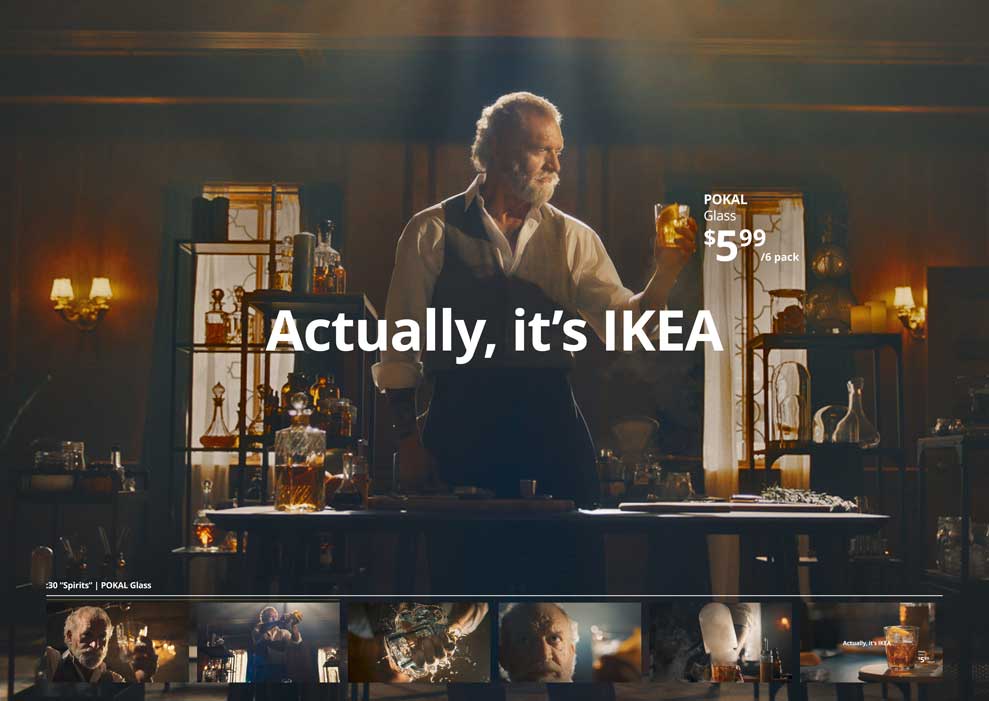
IKEA’s award-winning “Actually, It’s IKEA” campaign demonstrates why a creative idea must do more than attract attention; it must return that attention to the brand.
The advertisements initially resembled campaigns for high-end luxury goods. Their polished styling led viewers to assume they were looking at something expensive. The reveal that the products were from IKEA provided the surprise while reinforcing the company’s core promise: thoughtful design does not need to be financially out of reach (Marketing Awards, 2025).
The idea worked because it expressed something essential about IKEA. A campaign can be funny, beautiful or unexpected and still leave audiences unsure of what was advertised. If the idea fails to strengthen the brand’s identity, people may remember the joke while forgetting the company that told it.
Good creative makes people pause. Great creative ensures they remember why.
Impressions, likes, shares and views show that attention was captured, but not necessarily that the message was understood or the brand remembered. Attention is only the beginning. Strategy determines where it leads.
Going Viral Is an Outcome, Not a Strategy
Virality is seductive because it is visible. The numbers climb, the conversation expands and, briefly, the brand appears to be everywhere. But going viral is not a repeatable marketing plan. It is the possible result of timing, relevance, creativity and audience understanding.
Most businesses do not need a billion impressions. They need the right people to understand who they are, how they are different and why that difference matters.
At Graymatter Media, that is where we begin.
We help businesses uncover the ideas and points of difference that make them worth talking about, then translate those insights into marketing strategies, brand identities, campaigns, social content and digital experiences.
In today’s fast-paced and ever-changing business environment, success hinges not only on having great ideas but also on the ability to turn those ideas into reality. This is where strategic planning becomes indispensable. At Graymatter Marketing & Media, we specialize in helping businesses like yours formulate, implement, and evaluate comprehensive strategies that drive growth and success.
The Importance of Strategic Planning
Strategic planning is the cornerstone of any successful business. It involves setting clear objectives, identifying the necessary steps to achieve those goals, and allocating resources efficiently. Without a strategic plan, businesses often struggle to maintain focus, leading to wasted time, resources, and missed opportunities.
At Graymatter Marketing & Media, we understand that each business is unique. That’s why we tailor our strategic planning services to meet your specific needs, ensuring that your business plan, marketing plan, and advertising campaigns are aligned with your goals and the current market landscape.
Formulating Effective Business Plans
A well-crafted business plan is more than just a document; it’s a roadmap that guides your business through its various stages of growth. Whether you’re a startup looking to make your mark or an established company aiming to expand, we work closely with you to develop a business plan that outlines your vision, mission, objectives, and the strategies needed to achieve them.
Our team of experts conduct thorough market research, analyzes industry trends, and identifies your strengths and weaknesses. This comprehensive approach ensures that your business plan is not only realistic but also flexible enough to adapt to changing circumstances.
Crafting Impactful Marketing Plans
In today’s digital age, marketing is no longer a one-size-fits-all approach. It requires a deep understanding of your target audience, their behaviours, and the channels they engage with. At Graymatter Marketing & Media, we excel in creating marketing plans that resonate with your audience and drive measurable results.
From social media campaigns to content marketing and SEO strategies, we leverage a wide range of tools and techniques to enhance your brand’s visibility and reach. Our goal is to help you connect with your audience in meaningful ways, building brand loyalty and driving conversions.
Designing and Implementing Advertising Campaigns
An effective advertising campaign can propel your business to new heights. However, designing and implementing such campaigns requires careful planning and execution. We work with you to develop advertising strategies that not only capture attention but also inspire action.
Whether it’s a digital ad campaign, a print ad in a leading magazine, or a billboard in a high-traffic area, we ensure that your message is clear, compelling, and aligned with your overall strategic goals. Our team monitors and analyzes the performance of each campaign, making adjustments as needed to maximize impact and ROI.
Evaluating and Refining Strategies
The business world is dynamic, and what works today might not work tomorrow. That’s why we place a strong emphasis on evaluating the impact of the strategies we implement. By analyzing key performance indicators (KPIs) and gathering feedback, we can determine what’s working and what needs improvement.
At Graymatter Marketing & Media, we believe that strategic planning is an ongoing process. We continuously refine and adjust our strategies to ensure they remain effective and aligned with your business objectives.
Partner with Graymatter for Strategic Success
Success in business is rarely accidental—it’s the result of careful planning, execution, and continuous improvement. By partnering with Graymatter Marketing & Media, you gain access to a team of experts dedicated to helping you achieve your business goals through strategic planning.
Whether you need a comprehensive business plan, a targeted marketing strategy, or an impactful advertising campaign, we’re here to help you every step of the way. Let’s work together to unlock your business’s full potential and achieve lasting success.
In today’s fast-paced market, where consumers are bombarded with countless options and advertisements, establishing a strong brand identity is more crucial than ever. At Graymatter Marketing & Media, we specialize in creating powerful, recognizable brands that resonate with the right audience. Let’s delve into the significance of branding and identity and how we can help your business stand out in the crowd.
What is Brand Identity?
Brand identity encompasses everything that a brand represents. It’s the visual and emotional components that create a unique image in the minds of consumers. This includes the logo, colours, typography, tagline, and the overall tone and voice of the brand. A well-defined brand identity conveys the brand’s values, mission, and personality, making it easily recognizable and memorable.
Why is Branding Important?
Differentiation: In a saturated market, a strong brand identity helps differentiate your business from competitors. It gives consumers a reason to choose your product or service over others.
Credibility and Trust: Consistent and professional branding fosters credibility and trust. Consumers are more likely to do business with a brand that appears reliable and authoritative.
Emotional Connection: A compelling brand identity evokes emotions and creates a connection with the audience. This emotional bond can lead to customer loyalty and advocacy.
Memorability: Memorable brands are those that stick in the minds of consumers. Effective branding ensures that your business is easily recalled when the need for your product or service arises.
Our Approach to Building Strong Brands
At Graymatter Marketing & Media, we understand that effective branding goes beyond a logo or a catchy slogan. Our holistic approach ensures that every aspect of your brand is meticulously crafted to communicate your unique value proposition and appeal to your target audience.
Discovery and Research
We begin with a comprehensive discovery phase, where we delve into your business’s core values, mission, and goals. We also conduct thorough market research to understand your industry landscape and identify your ideal customer personas. This foundational work ensures that the branding strategy aligns with your business objectives and resonates with your target audience.
Brand Strategy Development
Based on our research, we develop a cohesive brand strategy that includes your brand’s positioning, messaging, and unique selling points. This strategy serves as a roadmap for all branding efforts, ensuring consistency and coherence across all touchpoints.
Visual Identity Design
Our creative team designs a compelling visual identity that includes your logo, colour palette, typography, and other design elements. These visual components are carefully selected to reflect your brand’s personality and appeal to your target audience. We create brand guidelines to ensure that your visual identity is consistently applied across all platforms.
Brand Messaging
We craft a unique brand voice and messaging that communicates your value proposition clearly and persuasively. Whether it’s your tagline, website copy, or social media posts, our goal is to ensure that your brand’s voice is consistent and engaging.
Marketing and Implementation
Once the brand identity is established, we develop targeted marketing strategies to reach your ideal audience. From digital marketing campaigns to social media management, we ensure that your brand is visible and engaging across all relevant channels.
The Graymatter Difference
At Graymatter Marketing & Media, we are passionate about helping businesses build strong, recognizable brands that stand the test of time. Our team of experts combines creativity, strategy, and data-driven insights to deliver branding solutions that drive results.
Whether you’re a startup looking to make a mark or an established business aiming to rebrand, we have the expertise and experience to help you succeed. Let’s work together to create a brand that not only stands out but also connects with your audience on a deeper level.
Ready to elevate your brand? Contact us today to get started on your branding journey with Graymatter Marketing & Media.
