
Most advertisements disappear almost immediately. We register the image, absorb a few words and move on. The rare campaign lingers, becoming a reference point or entering conversations the brand was never part of.
That kind of relevance comes from an idea people want to participate in, one that entertains while expressing something distinctive about the business behind it.
Lesson One: Personality Is Built Over Time
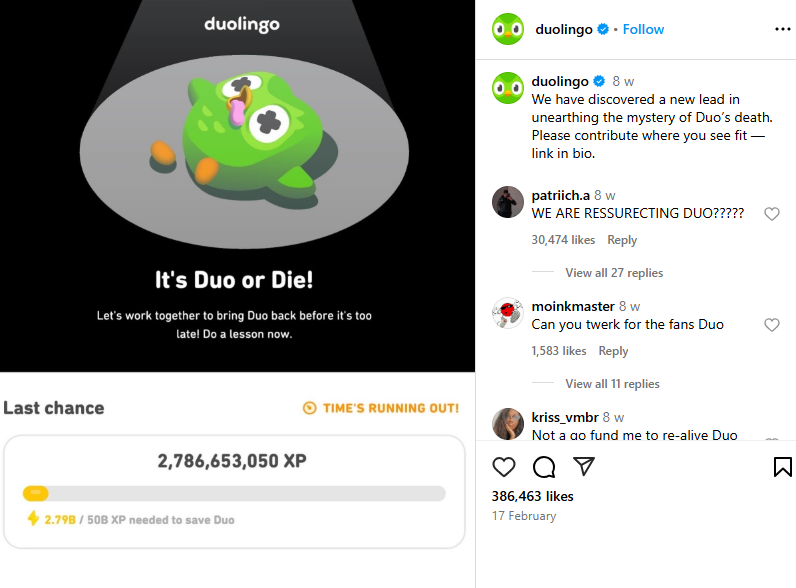
Duolingo shows what can happen when a brand stops speaking like an institution and begins behaving like a recognizable character.
In February 2025, the company announced the “death” of Duo, its famously persistent green owl mascot. What might have been a fleeting joke became a social media spectacle, generating 1.7 billion impressions within two weeks. Audiences mourned, speculated and joined the story, while other brands entered the conversation (Fast Company, 2025).
The campaign succeeded because audiences already knew Duo. For years, Duolingo had developed the mascot’s mischievous personality. Duo was no longer simply a logo, but an ongoing character with a sense of humour and mythology. When his death was announced, people understood the joke because they were already invested in his world.
That familiarity cannot be manufactured for a single campaign. Brand personality is created through repetition: the language a company uses, the stories it tells and the emotional impression it leaves.
Businesses must decide not only how their brand should look, but how it should sound, behave and make people feel. Those qualities should remain consistent across social media, advertising, websites and customer experiences.
When people recognize a brand before seeing its logo, it has created something more enduring than a memorable campaign. It has created a relationship.
Lesson Two: Familiar Products Need Unfamiliar Angles

Traditional water advertising relies on familiar ideas: hydration, purity, freshness and pristine mountain streams. Then there is Liquid Death.
With its irreverent name, tall cans and theatrical branding, Liquid Death treats water less like a household staple and more like an entertainment product. Comedy is not an occasional feature of its advertising; it is central to the brand’s identity (Shopify, 2025).
The product is simple. The perspective is not. That distinction matters in crowded industries, where competitors often offer similar products and describe them in nearly identical language. When every company promises quality, service and expertise, those claims begin to lose their impact. They may be true, but they are rarely memorable.
Originality does not always require a new product. Sometimes it begins by approaching a familiar one from an angle the category has ignored. Every business has its own history, personality and relationship with its customers. The creative opportunity lies in finding the story that could only belong to that brand.
The question is not, “How can we say this more loudly?” It is, “What can we say that no one else could say in quite the same way?”
Lesson Three: Attention Must Lead Somewhere
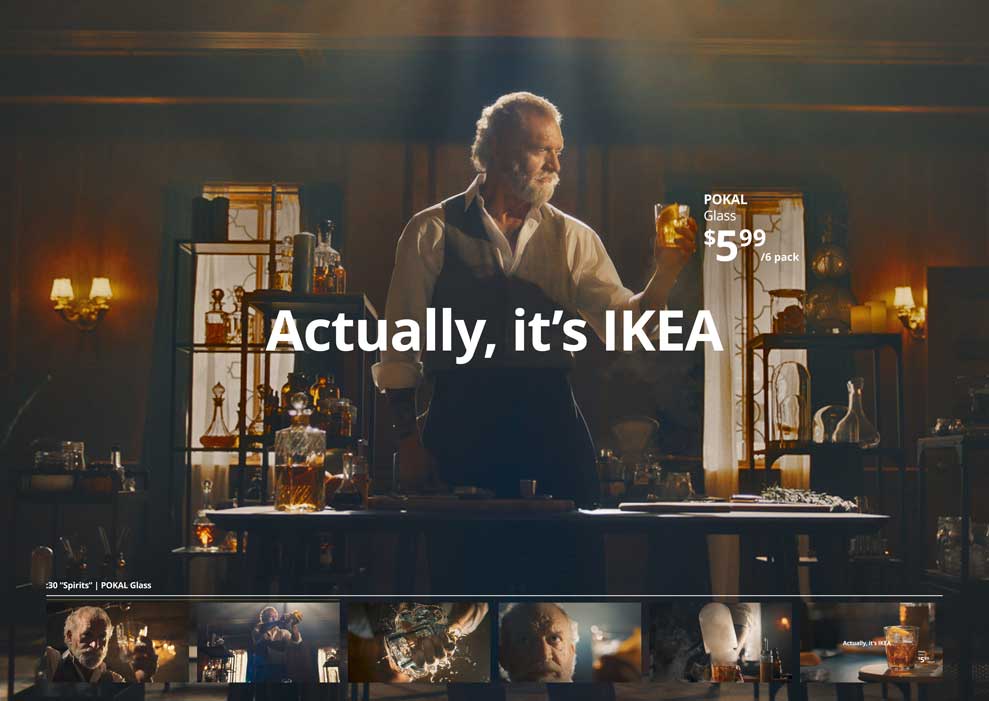
IKEA’s award-winning “Actually, It’s IKEA” campaign demonstrates why a creative idea must do more than attract attention; it must return that attention to the brand.
The advertisements initially resembled campaigns for high-end luxury goods. Their polished styling led viewers to assume they were looking at something expensive. The reveal that the products were from IKEA provided the surprise while reinforcing the company’s core promise: thoughtful design does not need to be financially out of reach (Marketing Awards, 2025).
The idea worked because it expressed something essential about IKEA. A campaign can be funny, beautiful or unexpected and still leave audiences unsure of what was advertised. If the idea fails to strengthen the brand’s identity, people may remember the joke while forgetting the company that told it.
Good creative makes people pause. Great creative ensures they remember why.
Impressions, likes, shares and views show that attention was captured, but not necessarily that the message was understood or the brand remembered. Attention is only the beginning. Strategy determines where it leads.
Going Viral Is an Outcome, Not a Strategy
Virality is seductive because it is visible. The numbers climb, the conversation expands and, briefly, the brand appears to be everywhere. But going viral is not a repeatable marketing plan. It is the possible result of timing, relevance, creativity and audience understanding.
Most businesses do not need a billion impressions. They need the right people to understand who they are, how they are different and why that difference matters.
At Graymatter Media, that is where we begin.
We help businesses uncover the ideas and points of difference that make them worth talking about, then translate those insights into marketing strategies, brand identities, campaigns, social content and digital experiences.